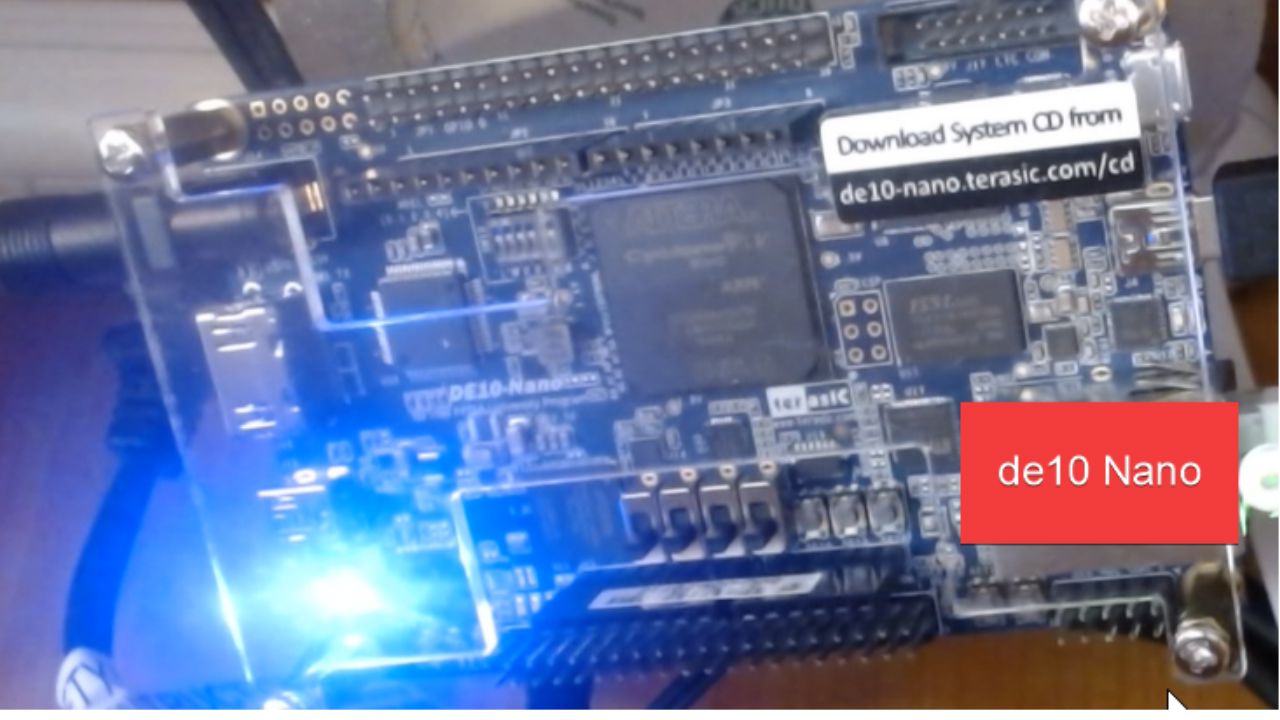
Why I Started Using This Tool
Every board I've worked with so far — including the BeagleBone Black in my last series — has the same limitation baked in: the hardware is fixed. You write code, and that code runs on a chip whose internal circuitry was decided long before you touched it. That's fine for a huge range of projects, but it also means there's a whole layer of embedded systems — actually designing the digital hardware itself — that I'd never touched. I picked up the DE10-Nano specifically to close that gap. It's an affordable way to get hands-on with a real SoC FPGA chip, one that combines a genuine ARM processor (so all the C and Linux skills I already have carry over directly) with an FPGA fabric I can program from scratch.
What It Does
The DE10-Nano is built around Intel's Cyclone V SoC FPGA, which is really two chips glued into one: a Hard Processor System (HPS) — a dual-core ARM Cortex-A9 that runs embedded Linux and C code just like the BeagleBone Black — and an FPGA fabric, a grid of reconfigurable logic you wire into custom digital circuits using VHDL or Verilog. The board also comes loaded with onboard hardware to experiment with immediately: LEDs, slide switches, push buttons, an ADC for reading analog sensors, and a built-in accelerometer connected over SPI. That combination means I can control the exact same LED either by writing a few lines of C on the ARM side or by building actual logic gates on the FPGA side — and directly compare what "software controls hardware" versus "you are the hardware" really feels like.
Here's the quick intro to the series and the board itself:
My Honest Pros & Cons
✅ What I Love
- The ARM side is a straight carryover — the HPS runs embedded Linux, so every sysfs trick, socket, and GDB workflow from the BeagleBone Black series applies here without relearning a thing.
- Onboard peripherals mean instant experiments — LEDs, switches, buttons, an ADC, and an SPI accelerometer are all populated on the board already, so there's no breadboarding required just to get a first signal moving.
- One LED, two completely different ways to drive it — toggling it from C on the ARM core versus wiring actual gate logic on the FPGA fabric makes the "software vs. hardware" distinction concrete instead of theoretical.
❌ What Could Be Better
- The FPGA toolchain is a real learning curve — Quartus, VHDL/Verilog, and pin-planning workflows are nothing like writing and compiling a C file, and the ramp-up is noticeably steeper than any SBC I've used.
- Smaller community than mainstream boards — documentation and troubleshooting threads exist, but there's nowhere near the volume of forum posts a Raspberry Pi or BeagleBone problem turns up.
- Two separate design worlds to keep straight — the HPS (software) and the FPGA fabric (hardware) each have their own toolchain, mental model, and failure modes, so there's more setup overhead than a single-CPU board.
Pricing: Is It Worth It?
The DE10-Nano itself runs around $130 — more than a BeagleBone Black, but still squarely hobbyist territory for a board with a real FPGA fabric on it. The software side costs nothing extra: Intel's Quartus Prime Lite is free and covers the Cyclone V, and the ARM side just needs the same free Linux/GCC toolchain used throughout the BeagleBone Black series.
My take: for the price of one mid-range SBC, you get an actual FPGA fabric bolted onto a real Linux ARM core — that's a lot of new ground to cover for not much extra cost.
Final Verdict
If you've only ever worked with microcontrollers or single-board computers with a fixed CPU, the DE10-Nano is a genuinely eye-opening next step. It's not the easiest board to get started with — FPGA design tools have a steeper learning curve than writing a Python or C script — but the payoff is worth it: you come away understanding not just how to write embedded software, but how the hardware underneath it actually works, and when you'd want to design your own instead of relying on someone else's chip. For anyone serious about embedded systems as a field rather than just a hobby, I'd recommend it without hesitation. This is going to be a fun series.